The BBS started to get popular in the nerdy crowd in Pune. Since I had recently graduated from PICT, my friends and colleagues there started using it, and then word of mouth spread rapidly through Pune.
Remember, this was in 1994 and BEFORE the internet. That was still about three years in the future. People were slowly becoming aware of email. Our BBS ran on the FidoNet dialup network. Each BBS node had a specific FidoNet address, and there were hundreds of such nodes already all over the world. Interestingly, the JabberWocky FidoNet address was 6:606/6. I was the sixth node in India after Suchit’s LiveWire Mumbai (1 & 2), Shamit Khemka’s LiveWire Calcutta (3), Loyola Joseph’s LiveWire Madras (4), Roopal Mehta’s CyberScope LiveWire Ahmedabad (5). Six also happened to be my lucky number.
All JabberWocky (JW) subscribers received a @6:606/6 email address. Mine was
gautam.godse@f6.606.z6.fidonet.org. Every night during low telephone rates, JW used to dial LW-Mumbai and exchange email. LW-Mumbai aggregated email from all LW nodes in India every night and dialed into the Singapore FidoNet node, which then dialed a node in the US. By morning, new email was ready to be downloaded by JW users. Mostly, users were on MS-DOS, and the email readers were simple text-based programs. Later on, we set up @livewire.net and @jwbbs.com domains for our user emails. Those were the first paid email addresses any Pune citizen ever had, besides the free ones from @ieee.org or ERNet email from IUCCA.
We also started selling modems with every JW subscription as that was the gateway required to access our services. Ravinder Obhan from Mumbai was a dealer for ZyXel modems and he cleaned up quite a bit selling these modems through us. Growth was slow but sure. We started getting coverage in PC-Quest magazine, and when they published our phone number, our subscriptions rapidly increased. But I still was puzzling over how to get the word out to the masses. Advertising in the newspaper was one sure avenue. As I reached out to some local newspapers like Sakal, Indian Express, Deccan Herald, Times of India, and reviewed their rates, an idea started to form in my mind.
Why pay for advertising when I could get written up in these newspapers by the journalists themselves? I discussed it with my brother, Vikram, and we decided to organize a seminar on “digital communications” called prophetically “Connect 2001.” I invited Suchit and Satish Gurjar, a known tech journalist/writer from Pune as my panel guests. For the venue, I selected a familiar place—the big auditorium at the Institution of Engineers near COEP. That venue used to host a big book fair annually, and I was intimately familiar with the facility. We even organized lunch for all seminar attendees. Things were falling into place.
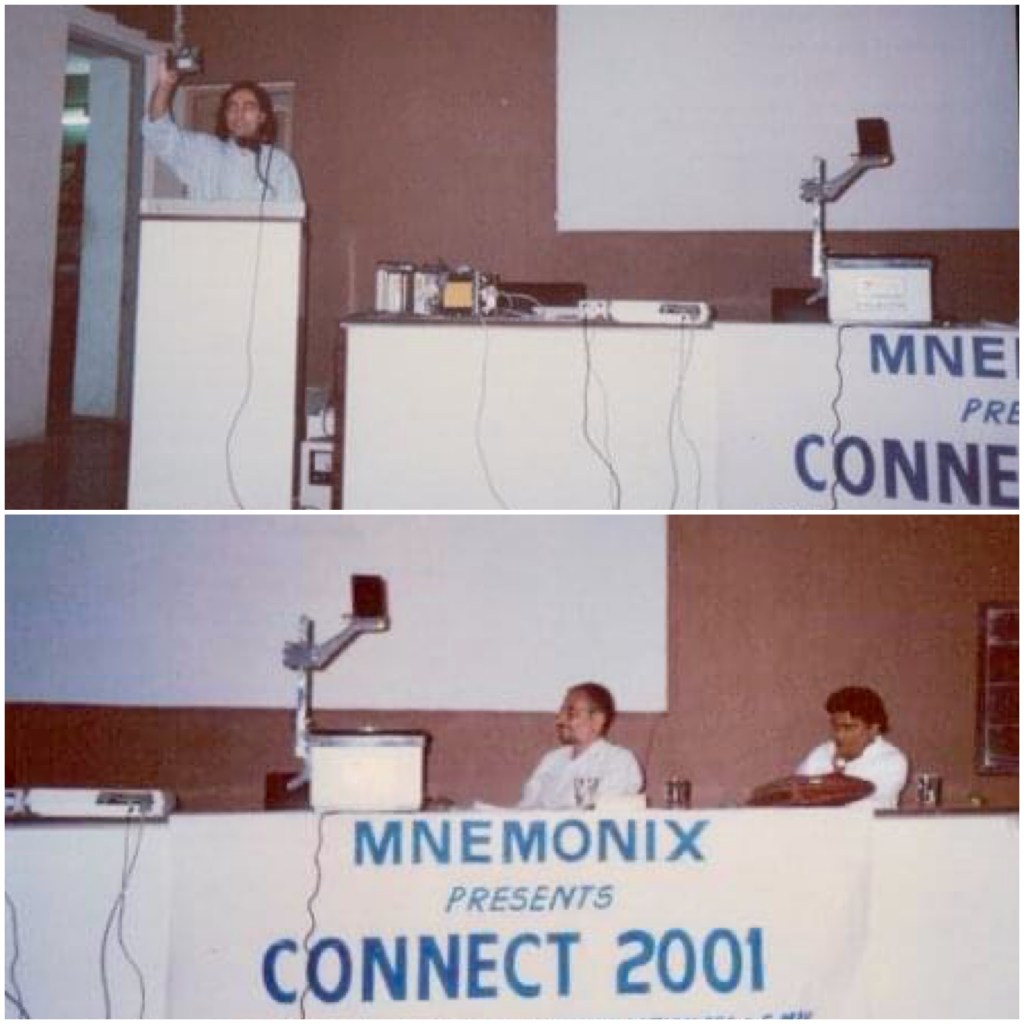
Then I had the bright idea of giving a live demo of the BBS to all the attendees. This meant that we needed a PC, a digital projector, and most importantly a live phone line on stage. The first two were easy to organize. The phone line was a puzzle. The institute did not allow me to use their phone line, which anyway was in their office, some distance away from the auditorium and the stage. I then opened the Pune Telecom directory. There was a list of services that Pune Telecom provided, and as I pored over them, I found a “Tatkal” (Instant) phone line service available for a day. That would do it.
I went to the Pune Telecom main office on Bajirao Road and applied for a “Tatkal” line. For the location, I gave the Institute of Engineers address. The clerk asked me for a more specific location, and I told him where I wanted it and for what I needed it. His eyes grew big, and I could see that maybe he was going to be difficult. Turned out the opposite. He was keen on what a “BBS” was and called in his colleagues to have me explain to them what I was doing. They approved the “Tatkal” line immediately.

Once that was secured, we placed an ad in the local newspapers and hoped that people would show up. There was no WWW yet, so I couldn’t list a website address in the ad where people could go to register. I had a phone number where people could dial and RSVP. I don’t think we got a lot of people dialing with their RSVP. On the day of the event, we still didn’t know how many people would show up. In the morning, I was frantically trying to set up the PC and projector on stage. As promised, the telecom guy turned up on time. He climbed a local telephone pole just outside the gates of the Institute and connected a 100-foot telephone cable to the pole junction box. He then ran that wire onto the stage at the auditorium, and we connected it to the modem. Got a dial tone, and we were in business!
My masterstroke to invite the journalists of every newspaper in town worked spectacularly well. They all turned up with the promise of free lunch and something interesting to see and write about. As the demo progressed, I could see them get excited and elated about the power of digital communications. The next few days, they all wrote about JWBBS in their newspapers, and we suddenly got the free publicity that catapulted us into profitability. We grew our subscribers from a few hundred in the first few months to three thousand by the end of 1994.
It was time to incorporate a business. As the money started coming in, I realized that my finance skills were woefully inadequate. I had gotten together again with Hoofrish, my girlfriend at that time. She had done a finance management course with Anil Lamba, who was friends with her dad. Her dad, a Chartered Accountant turned entrepreneur, ran an aerosol factory and had hoped that his daughter would help out in the business and needed some finance skills. She mentioned it to me, and I was immediately interested. I signed up for the course, which was conducted by Anil himself at the Blue Diamond Hotel in Pune, a posh 5-star hotel at that time.
Through the duration of that course, I realized I needed to incorporate a company and accordingly, I found out the process for doing so. One day, I went to the Company Registrar office near Tilak Maharashtra Vidyapeeth in Mukund Nagar.
The clerk at the window took my form, read through it, then looked me up and down and said, “जा वडिलांना घेवून ये” (“Go get your father”).
I was puzzled and asked him why. He said that the owner of the company needs to be there to sign in front of him. I explained to him that I was the owner. He was incredulous. Remember, I was only 25 at that time and was a short, skinny guy who looked maybe like an 18-year-old kid. He refused to believe that I was the owner of the new company we were forming. Somehow, I finally convinced him, and he let me sign the forms and file the incorporation certificate.
Mnemonix InfoNetworks Pvt. Ltd. was now alive.
 Gautam Godse