Dejected after my F-1 student visa got the ax at the US Consulate, I knew I had to shake things up. Fresh out of college in ’92, I persuaded Mr. Ramakrishna, or RK as we fondly called him, to start an R&D lab at PICT. Under the aegis of the Society for Computer Technology & Research (SCTR), we, a quartet of rebels—Altaf, Omkar, Sandeep, and I—snagged a room in the PICT building and made it our lab. We did legitimate projects for PICT and RK’s electronics firm, Lectrotek, but our pièce de résistance? Setting up a Novell Netware server and a coaxial token ring network. Testing it meant endless hours of multiplayer DOOM and Microsoft’s network card game Hearts. Fun times.
Returning from Mumbai, an ad caught my eye—a software developer gig at Aptech in Mumbai. I applied, and soon enough, I was back in Mumbai, interviewing with Raju Chellam, the CBT division head. Raju, a delightful nerd who I still keep in touch with, grilled me a bit, had his team test my C coding skills, and voila—I was hired on the spot. A salary jump from ₹2,500 to ₹5,000? Yes, please. I informed RK and my parents, who were all in.
Settling into a company flat in Kandivli with five other colleagues was a crash course in collaboration and compromise. One roommate, Rishi, had a quirky morning ritual involving drinking two liters of water before his bathroom visit, saying, “प्रेशर नहीं आ रहा” (“I’m not feeling the pressure yet”). Those flatmates? Still friends. Rishi, I hope the pressure is off 😀.
Aptech’s corporate life demanded a strict dress code—formal shirts, ties, trousers, and leather shoes. Our laundry guy loved it. Morning commutes were an adventure, sometimes hitching a ride with the boss or a roommate’s motorcycle. The corporate grind was novel and exciting, a stark contrast to my college days at PICT-SCTR.
My immediate boss, Danesh, a half-Parsi with whom I clicked instantly, assigned me cool projects and solving Novell Netware network issues. Me being a social butterfly, I quickly made friends across Aptech’s divisions. One notable friend was Deepa (not her real name), our CEO Ganesh Natarajan’s secretary. She sat outside the CEO’s office in her own little nook that had her desktop computer—a pretty ordinary Intel 486 PC with one extraordinary accessory. It had a “modem” connected to it. For a few weeks, I had no idea this computer and modem existed.
Until one week, in early 1994, in my latest copy of PC-Quest magazine, I read an article on something called a Bulletin Board System (BBS). The article was by the computing and communications pioneer in India, Atul Chitnis. Captivated by the article, I read instructions on how to connect to a BBS, and there, published at the end of the article, were phone numbers for a few BBSes in India. There were a couple in Delhi, one in Bangalore, and one in Mumbai. The Mumbai BBS was called LiveWire! and the SysOp (System Operator/Owner) was named as one Mr. Suchit Nanda.
I shared the article with my office colleagues and wondered where I could find a modem so I could connect to LiveWire! BBS. One of my friends casually mentioned that Deepa’s computer had a modem. That piqued my interest, and I went around to her office, and lo and behold, there was a square box sitting on top of her tower 486 PC. I asked her if that was a modem, and she nodded her head to confirm. I asked her if I could use it, and she immediately said, “No, no, baba. Boss won’t allow.” I thought of going to Mr. Natarajan and asking him directly, but that would have been out of line, since I was still a lowly developer. I decided, as I usually do, I would rather keep this to myself for now.
Then, on a Friday, as everyone left work a bit early, I hung around working on my project a bit longer. As the office emptied, I strolled around to Deepa’s office and confirmed that Mr. Natarajan and she had left. Luckily her office had no door. It was just an annex outside the CEO’s office. With mounting courage, I switched on the PC and the modem. In those days, there were no passwords for computers. It booted up into MS-DOS, and I could use the computer normally. The BBS issue of PC-Quest magazine had helpfully come with a CD-ROM with software programs. There were several that allowed me to connect to any BBS. I copied over a couple of those to the local PC hard drive and fired one up. Using the instructions in the article, I dialed the number for LiveWire! BBS and for the first time heard the distinctive “modem song” of connection. In a few seconds, the display on the screen changed and the “Welcome to LiveWire! BBS” text scrolled down on the screen.
I was connected to the future.
Reviewing the menu options on the screen, I saw one labeled “Chat with SysOp.” I chose that, and soon it was pinging the “SysOp.” The screen cleared, and someone at the other end typed, “Hello, this is Suchit Nanda. Welcome to LiveWire!”
With those words began a friendship and mentorship that has lasted till today. Suchit was extremely smart, friendly, and a nerd like me. We got along on chat like wildfire. I immediately asked him if I could come visit him and check out his setup. He invited me over to his flat in Hiranandani Gardens the next day.
The next few months I spent learning the ins and outs of running a BBS. An idea was beginning to form in my mind. I pitched it to Suchit, and he was instantly on board.
I was going to launch a BBS in my hometown, Pune.
On my next trip back home, I shared this idea with my parents. They were, of course, clueless as to what a BBS was, but they always supported any harebrained scheme I came up with. Or rather, I didn’t give them much of a choice. I also roped in my brother Vikram, who was still in college at that time and started educating him on the world of BBSes.
With a loan of ₹1 lakh from them to buy a high-end Intel 486 computer with 16 MB (not GB) of RAM and a 120 MB (again, MB not GB) hard drive, I was ready to launch this venture. Suchit secured a copy of the WildCat! BBS software for me on one of his many visits to the US. One of his hardware dealers supplied me the modem. A blazing fast 14.4 Kbps ZyXel modem that I paid an astonishing ₹14,000 for. At that time in 1994, that was quite a lot of money.

Now I just needed a couple of phone lines. In India, getting a phone line in the eighties and early nineties was still a bureaucratic affair. It took years to get one. Unless you happened to be a doctor. Then you could get a phone line within a month. Luckily, both my parents were doctors. It’s funny how things start falling in place when you make the effort. We already had one phone line at home, and we applied for another in my mom’s name and got that set up in a couple of weeks. As I was ready to pull the trigger, I spoke to my bosses Danesh and Raju at Aptech and updated them on my plan. They were supportive but sorry to see me go.
I resigned and headed back home, excited at the prospect of kicking off my first “startup.” At that time, in the pre-internet era, no one called it a “startup.” It was just a new business.
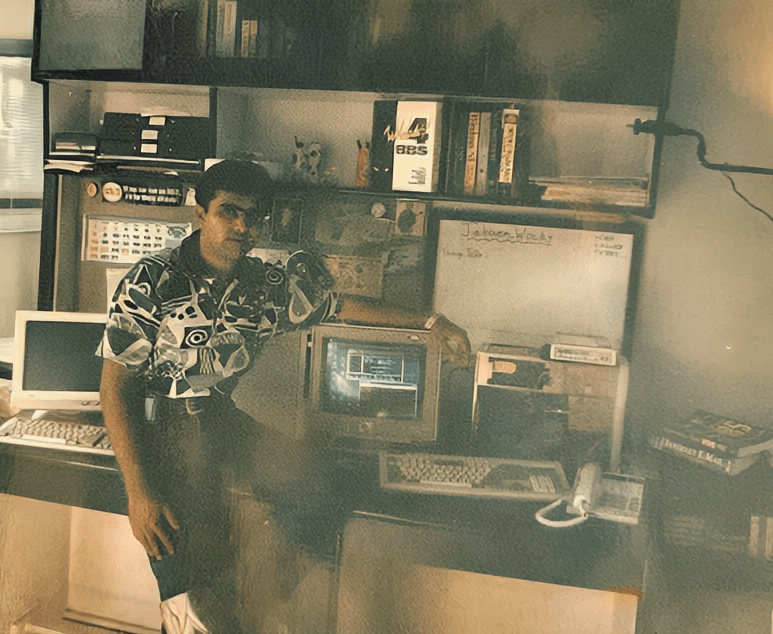
From the time the idea entered my head to the point of launch, it had been just about six months. Things had happened very quickly. Suchit had been setting up franchises of LiveWire! BBS in Calcutta, Ahmedabad, and Baroda. Pune would be a new one, but I was clear that it would not be named “LiveWire!”—even though that was a really great name for a BBS.
There was only one name that I felt was right for this new era of communications. Having been a fan of Lewis Carroll, I had memorized his famous poem in his book “Through the Looking Glass.”
So on October 1, 1994, without much fanfare, my brother Vikram, who was 20 at that time, and I, at 25, booted up WildCat, turned on the modem and launched our first startup.
The very first BBS in Pune.
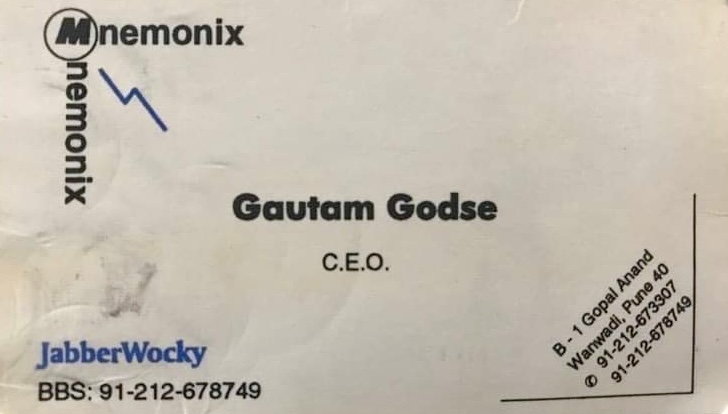
JabberWocky.
 Gautam Godse